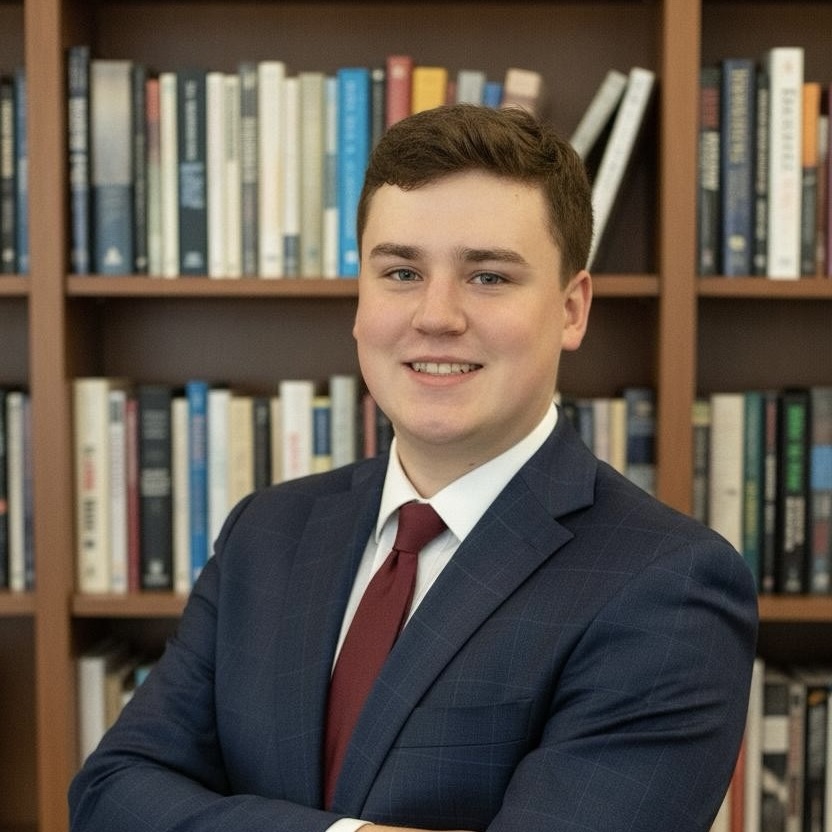
I am a law student at American University Washington College of Law, driven by a commitment to justice, accountability, and human rights. My academic and professional work centers on international criminal law, international humanitarian law, and domestic criminal law, with the goal of pursuing a career in public service as a prosecutor and advocate.
My legal experience spans international and domestic practice. I am currently an extern with the Special Prosecution Division of the Montgomery County State's Attorney's Office, where I work on serious felony matters, including trial preparation, evidence analysis, and prosecutorial strategy. This summer, I will serve as a Rule 9 Legal Intern with the Snohomish County Prosecutor's Office, further developing practical experience in criminal prosecution.
My research examines the intersection of law, armed conflict, and corporate responsibility. I have published on corporate accountability for war crimes in the Democratic Republic of the Congo in the Human Rights Brief and contributed to the Asser Institute's International Crimes Database. This work reflects my commitment to ensuring that both individuals and institutions are held accountable for violations of international law.
In addition to research, I have gained practical experience in peacebuilding and international legal processes. With the Public International Law & Policy Group (PILPG), I supported peace negotiations through legal research and drafting memoranda, gaining insight into how law operates in conflict resolution and post-conflict transitions. I also studied international criminal law and counterterrorism at the Asser Institute in The Hague, deepening my understanding of global justice in practice.
Before law school, I worked in information technology as a project manager and IT assistant, leading web development initiatives and supporting infrastructure projects involving wireless networking and A/V systems. This technical background strengthened my ability to manage complex projects, collaborate across disciplines, and adapt quickly in high-pressure environments.
Whether through courtroom advocacy, public service, or legal scholarship, I seek to promote accountability and uphold the rule of law at both the domestic and international levels.
International Criminal law
Human Rights Law in Armed Conflict
Corporate Responsibility & Business and Human Rights
International Humanitarian Law
Public International Law & International Institutions
Comparative Criminal Law and Prosecution
2024 – 2027
Activities: Human Rights Brief, Senior Columns Editor | War Crimes Research Office, Blog Writer
Study Abroad: T.M.C. Asser Institute, The Hague, NL, June 2025
2020 – 2023
Minor in Law, Societies, and Justice
Honors: Dean's List
Activities: Phi Alpha Delta Pre-Law Fraternity, Social Committee Member
January 2026 – Present
August 2025 – December 2025
June 2025 – February 2026
June 2025 – August 2025
October 2023 – July 2024
October 2021 – March 2023
January 2019 – December 2024
Vol. 29 No. 1 2026 This column argues that governments can curb corporate complicity in atrocities by strengthening legal regimes governing conflict minerals and corporate accountability. Using the Democratic Republic of the Congo as a case study, it explains how multinational tech companies indirectly finance armed groups through opaque mineral supply chains, while gaps in ICC jurisdiction and weak disclosure rules shield executives and firms. Examining the UN Guiding Principles, a draft binding business and human rights treaty, and contrasting U.S. and EU approaches, the column urges enforceable due diligence, meaningful sanctions, and treaty-based oversight to align global commerce with basic human rights norms.
September 30, 2025 This blog post argues that U.S. tech companies risk liability under the Alien Tort Statute when they design and configure products domestically for use in abuses abroad. Focusing on Doe I v. Cisco, it explains that the Ninth Circuit allowed claims to proceed based on allegations Cisco customized China’s “Golden Shield” from California, knowing it would help persecute Falun Gong practitioners. Unlike cases involving mere corporate presence, this decision signals that intentional, U.S.-based technical support can ground aiding-and-abetting liability, pushing companies toward robust human rights due diligence and more accountable innovation in global surveillance and supply-chain markets.
April 20, 2025 This blog post argues that states can address monopoly-driven slow speeds, predatory pricing, and limited access to essential internet services by exercising eminent domain over Comcast's physical network infrastructure and opening it to competitive providers. Drawing on Kelo v. City of New London, the blog post contends that a well-designed, community-wide plan satisfies the Fifth Amendment's “public use” requirement and the just compensation standard. Given the internet's central role in work, education, and civic participation, public control of infrastructure advances equity and efficiency while remaining within the powers of a democratically accountable government.
February – April 2025 Reported on developments on the International Criminal Court's investigation into the Situation in Ukraine and Preliminary Investigation into the Republic of Belarus.
Email Me At
Location
Seattle, WA
Washington, DC